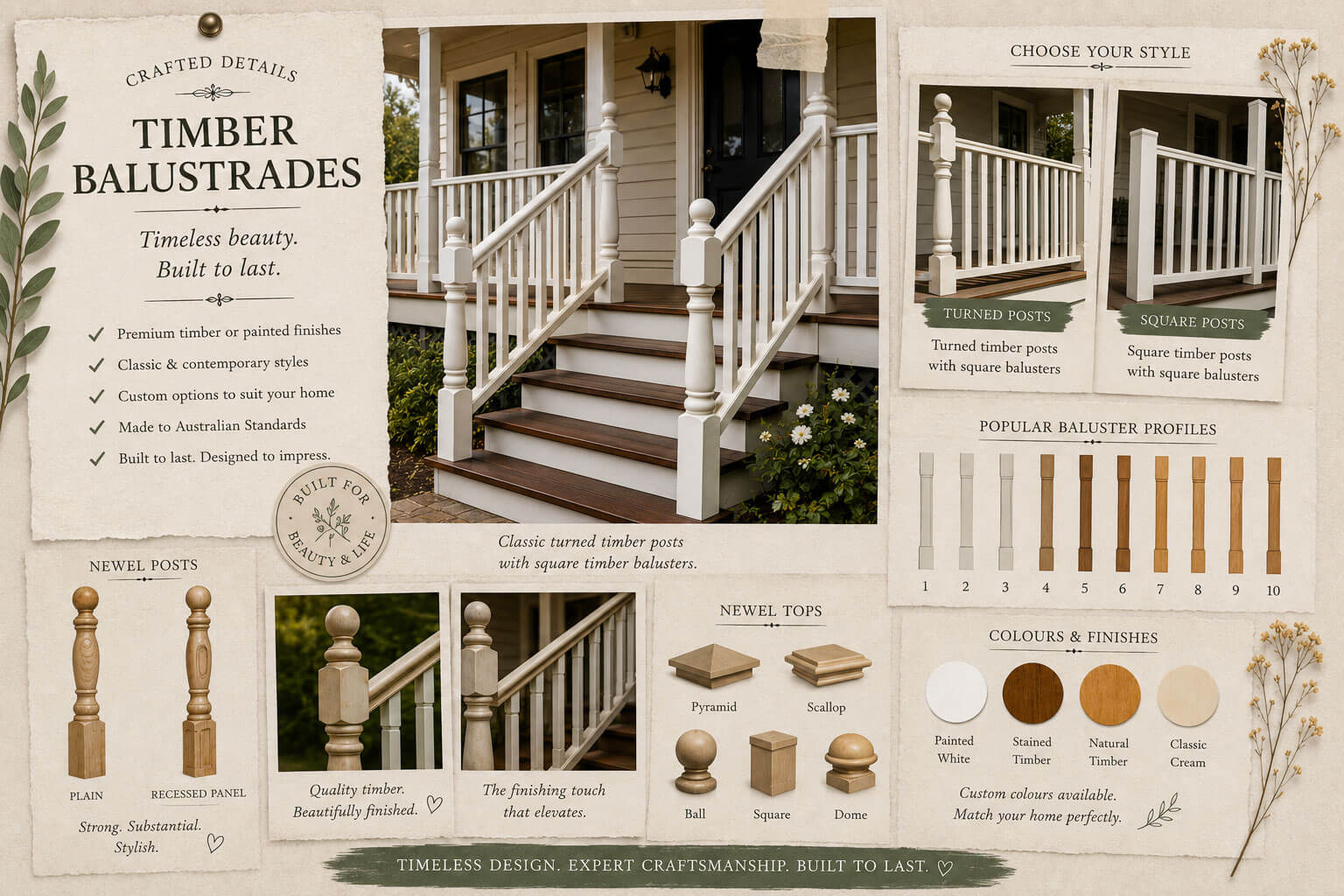
Choosing the right balustrade shapes both the safety and the character of a home, and across Melbourne more owners and builders are turning to assembled timber panels for a faster, cleaner result. This guide walks through what these balustrades are, where they suit best, the timber options available, and the standards you need to meet.
What Is an Assembled Timber Balustrade?
An assembled timber balustrade arrives as a finished, ready-to-fix panel rather than a loose bundle of parts. Instead of measuring, cutting and joining individual balusters on site, the tradesperson simply positions and fastens a complete section. The advantages of this approach are considerable.
- Installation is quicker because the hard work is already done
- Baluster spacing stays even and predictable across every panel
- The finished look is tidy and uniform
- On-site labour, cutting and fiddly assembly are kept to a minimum
Where Are Timber Balustrades Used?
Timber balustrading turns up in a wide range of settings, both outside and in. You will find it enclosing verandahs, porches, decks and balconies, running alongside external and internal staircases, and forming a key part of heritage restorations where period detailing matters. Its versatility is a big reason it remains a favourite for Melbourne homes.
Standard Versus Custom Timber Balustrade Designs
When it comes to selecting a panel, the first decision is whether an off-the-shelf design will do or whether the job calls for something bespoke.
Standard Designs
Standard balustrades are the sensible choice for most projects. They come at a lower price, are manufactured more quickly, and rely on proven profiles that have been fitted to countless homes. Installation is straightforward and the appearance is consistent from one panel to the next.
Custom Balustrades to Match Existing Homes
Where a property has particular character worth preserving, a made-to-match panel is the way to go. Custom balustrades are ideal for Victorian, Federation, Edwardian and Queensland-style homes, heritage-listed buildings, and new builds designed in a period style. Reproducing an existing profile keeps the look authentic and the transition seamless.
Timber Species for External Balustrades
The species you choose affects durability, finish and cost. Three options cover most external applications.
Treated Pine
LOSP H3 treated pine is the budget-friendly all-rounder. It takes paint beautifully, resists termites and stands up well to outdoor exposure, making it a dependable pick for painted balustrades.
Hardwood
For extra longevity and a rich natural look, hardwoods such as spotted gum, blackbutt and merbau are hard to beat. They suit stained or clear finishes and reward owners who want the grain to show.
Clear Pine
Clear pine sits at the premium end for painted work. With minimal knots and a smooth face, it delivers a refined finish where appearance is the priority.
Balustrade Compliance and Australian Standards
Balustrades are a safety feature first, so the National Construction Code (NCC) sets firm rules you must follow. Keep these key figures in mind.
- A balustrade is required wherever the drop exceeds 1 metre
- Minimum height is 1000 mm for balconies, decks and landings, and 865 mm measured above the stair nosing line
- Gaps must not let a 125 mm sphere pass through, which controls how far apart the balusters sit
- Where the drop is over 4 metres, no climbable horizontal elements are permitted between 150 mm and 760 mm
Getting spacing and height right is not optional. Pre-assembled panels help here because the baluster gaps are set accurately at the workshop, removing the guesswork on site.
Why Builders and Homeowners Choose Assembled Panels
The appeal of a pre-made panel comes down to time and certainty. Because the assembly is finished before delivery, crews spend far less time on site, labour costs drop, and projects reach completion sooner. Just as importantly, factory assembly all but eliminates the uneven spacing that can creep in when balusters are fitted by hand. For anyone weighing up options, our full range of timber balustrades and verandah products shows what can be supplied ready to install.
Making the Right Choice
The standard-or-custom question usually answers itself once you look at the building. If you are matching existing period features, a custom panel is the only way to get a faithful result. If the home is new or the styling is flexible, a standard design offers the best value without compromising on quality or compliance.
Assembled timber balustrades are proudly Australian made and part of the long-running heritage timber tradition carried on by Karem Woodcraft, the parent company behind the original range. With fretwork and balustrades priced per lineal metre and delivery available Australia-wide, fitting out a Melbourne verandah or staircase has never been simpler.