If you own or restore a period home, you have almost certainly noticed the small decorative timber brackets that soften the joints and rooflines of traditional Australian architecture. Two of the most frequently confused are corner brackets and eaves brackets, so here is a clear, practical guide to telling them apart.
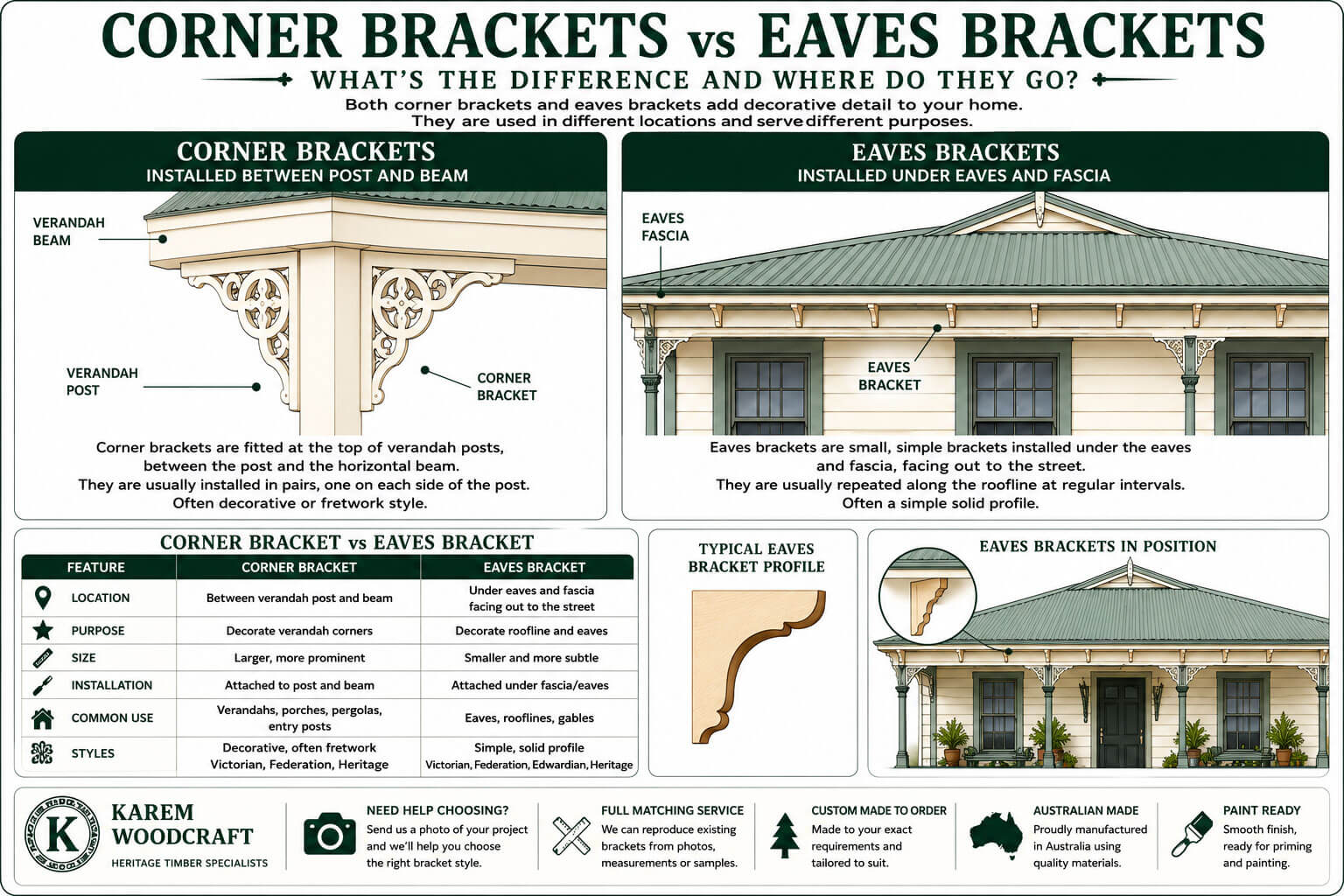
The short answer is location. A corner bracket lives up on your verandah where the post meets the beam, while an eaves bracket tucks in beneath the eaves or fascia and faces out towards the street. Get that distinction right and the rest of the terminology falls into place.
What Is a Corner Bracket?
A corner bracket is a decorative timber bracket fitted at the head of a verandah post, in the angle where the upright post meets the horizontal beam sitting above it. Because they occupy such a prominent spot at eye level, corner brackets tend to be larger, bolder and more ornate than their eaves cousins, often featuring pierced fretwork or flowing scrolled profiles.
You will most often find corner brackets on:
- Timber verandahs and entry porches
- Victorian and Federation homes
- Heritage cottages and restorations
- Traditional Australian verandahs with turned posts
What Is an Eaves Bracket?
An eaves bracket is a smaller decorative bracket installed under the eaves, fascia or roofline. Rather than sitting at a corner joint, it faces outward towards the street and is usually repeated at regular intervals along the front elevation. Compared with a showy verandah corner bracket, an eaves bracket is generally more restrained, more compact and frequently cut as a solid profile rather than pierced fretwork.
Eaves brackets typically appear on:
- Eaves and fascia boards
- Gable ends and rooflines
- Window hoods and awnings
- Federation, Victorian and Edwardian heritage facades
Corner Bracket vs Eaves Bracket: A Quick Comparison
If you only remember a handful of points, make it these. The two brackets differ mainly in where they sit, how big they are and how decorative they tend to be.
- Position: corner brackets sit between post and beam; eaves brackets sit beneath the eaves or fascia, facing the street.
- Job: corner brackets dress up verandah corners; eaves brackets decorate the roofline.
- Scale: corner brackets are larger and more eye-catching; eaves brackets are smaller and subtler.
- Style: corner brackets lean ornate and are often fretwork; eaves brackets are usually simpler, solid-profile shapes.
- Where used: verandahs, porches and posts for the former; fascia, gables and rooflines for the latter.
Where Do Corner Brackets Go?
Corner brackets are mounted at the top of each verandah post, bridging the gap between the vertical post and the horizontal beam. The result is a graceful transition that visually ties the two timber members together and adds character to the whole verandah. They are a defining feature of Victorian verandahs, Federation verandahs and sympathetic heritage restorations across Melbourne and beyond.
Where Do Eaves Brackets Go?
Eaves brackets are fixed underneath the eaves or fascia and turned to face the street, then spaced evenly along the roofline so the rhythm reads clearly from the footpath. Being smaller than verandah corner brackets, they usually carry a simple solid outline rather than delicate pierced detailing, which keeps them in proportion with the roofline they decorate.
Victorian Brackets vs Federation Brackets
The era of your home is a useful guide to the bracket style that will look right. Two broad traditions dominate Australian heritage timberwork.
Victorian Timber Brackets
Victorian-era brackets are the more elaborate of the two, drawing on scrollwork, lacework and generous curved profiles. They suit late-1800s homes and any restoration aiming to recapture that decorative Victorian verandah look.
Federation Timber Brackets
Federation brackets are cleaner, more geometric and more architectural in feel. They complement early-1900s Federation, Edwardian and other traditional Australian homes where restraint suits the overall design.
Choose a Standard Profile or Have Yours Matched
Whether you are working from a single surviving sample or starting a whole facade from scratch, both routes are available. As part of the Karem Woodcraft heritage family, Classic Woodturning manufactures decorative timber brackets for verandahs, eaves, fascia, gables, rooflines and full restoration projects, right here in Bayswater, Victoria, with delivery Australia-wide.
We can help with corner brackets, eaves brackets, gable brackets, verandah brackets, Victorian and Federation styles, and fully custom or matched designs. Not sure which one you need? Send us a photo of where it is going and we will tell you whether it is a corner bracket, an eaves bracket, a gable bracket or another decorative component, then point you to the right option in our range of heritage timber products.
Frequently Asked Questions
What is the difference between a corner bracket and an eaves bracket?
A corner bracket is usually fitted between a verandah post and its beam, while an eaves bracket is fitted under the eaves or fascia and faces out to the street.
Are eaves brackets smaller than corner brackets?
Yes. Eaves brackets are generally smaller and simpler than corner brackets and often use a solid-profile shape rather than pierced fretwork.
Can you match my existing brackets?
In most cases, yes. We can often reproduce existing corner brackets, eaves brackets and other decorative timber brackets from a photo, a set of measurements or an original sample.
Still unsure which bracket suits your home? A quick photo of the spot it needs to fill is usually all we need to recommend the correct profile and finish.