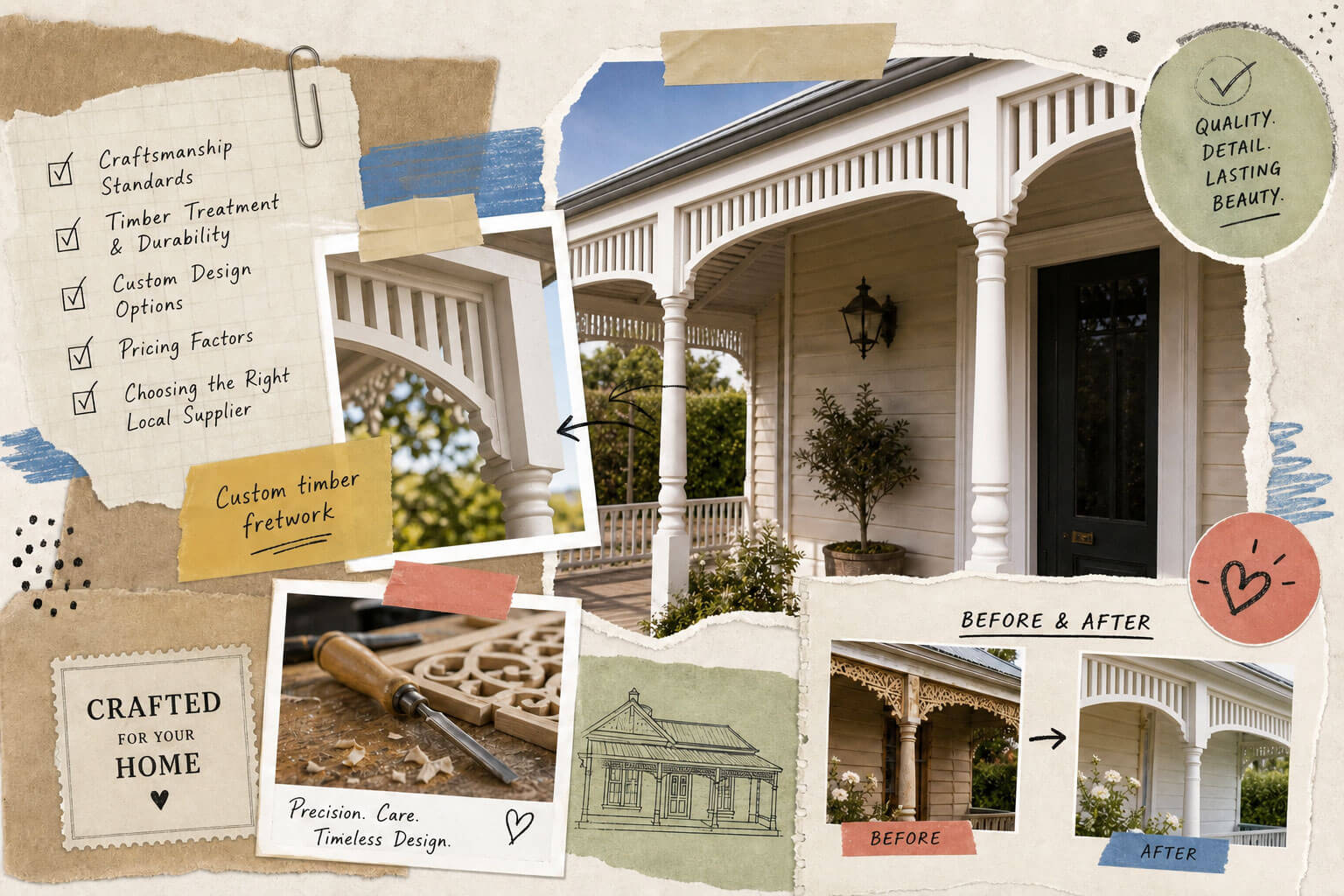
Search for timber fretwork online and you will quickly notice that half the listings point to guitar workshops rather than heritage woodworkers. Sorting genuine architectural specialists from general joinery shops takes a little know-how, and this guide walks Melbourne and Victorian homeowners, builders and restorers through exactly how to do it.
Finding Real Fretwork Specialists, Not Guitar Shops
The confusion starts with the word itself. In architecture, fretwork means the lace-like decorative timber panels fixed to verandahs, gable ends and frieze boards on Victorian, Federation and Edwardian homes, not the metal strips on a fretboard. Once you know that, filtering search results becomes far easier, and you can skip the wrong phone calls entirely.
This distinction matters because the supplier you choose is the single most important decision in the whole project. A general joiner can certainly cut timber, but period-accurate fretwork depends on pattern libraries, heritage-matching experience and a practical understanding of how decorative panels survive outdoors over many years. Long-standing makers such as Karem Woodcraft, whose original heritage range has served Australian restorations for decades, set a useful benchmark to measure any local option against.
Where Fretwork Actually Goes
Common positions include verandah brackets, frieze panels below the roofline, gable infills, balustrade screens and decorative internal openings. Each carries different exposure demands. External panels face UV, rain and often termite pressure, while internal panels face almost none of that. Knowing where your fretwork will sit helps you ask sharper questions the moment you call a supplier.
Comparing CNC, Laser and Hand-Cut Production Methods
How a panel is cut shapes both its look and its price. Each method has genuine strengths, so match the process to your brief rather than the cheapest option in the workshop.
CNC Routing
CNC routing handles thicker stock, delivers repeatable cuts and suits mid-to-large panel runs efficiently. Its unavoidable trade-off is slightly rounded internal corners, since the router bit has a fixed radius. Ask about bit diameter, tolerances and how they tackle tight internal geometry on complex heritage patterns, and always ask to see finished samples rather than digital renders.
Laser Cutting
Laser cutting produces crisp, fine detail on thinner material, sharper than a router bit can manage. The limitation is depth, and cut edges may show faint heat tinting. It is excellent for interior panels; for exterior use, ask specifically about edge sealing and whether the cut edge takes paint well over time.
Hand-Cut Fretwork
Hand work is the slowest and dearest method, yet sometimes it is the only way to reproduce an unusual pattern from a period home. A trustworthy supplier will recommend the method that genuinely suits your job rather than defaulting to whatever is quickest for them.
Timber, Treatment and Finish Questions to Ask
For external fretwork on verandahs, gables and exposed friezes, the timber must resist moisture, UV and, where relevant, termites. Treated pine, Western Red Cedar and selected Australian hardwoods are common exterior choices, while Victorian ash suits painted or more sheltered positions. Internal work opens up a wider range of species and substrates because the exposure is much lower.
Treatment is non-negotiable for external pine. LOSP (light organic solvent preservative) is the benchmark for exterior decorative pine, guarding against termite attack and fungal decay. A maker that treats timber in-house can guarantee consistency and full traceability; where treatment is outsourced, insist on documentation of the exact level applied to your order.
Choosing the Right Finish
- Paint gives the strongest external protection and is easy to inspect and re-coat.
- Spar or marine varnish shows off natural grain but usually needs recoating every one to two years in exposed spots.
- Penetrating oils are the lowest-effort to touch up but offer the weakest weather protection.
Ask whether panels arrive pre-primed and what maintenance schedule suits your particular position before signing off.
Matching Your Home's Period Style
Customisation depth is one of the clearest signs of a true specialist. Look for both a standard catalogue and a fully bespoke service. Catalogue panels suit tighter budgets and timelines where exact matching is not critical, while bespoke work becomes essential when new panels must align precisely with existing heritage detail. You can browse a supplier's full range of decorative timber products to gauge how deep their standard and custom options run.
Ask for period-matching examples specifically, not just general portfolio shots. A maker who has reproduced Federation or Edwardian patterns will understand the proportional rules without a lengthy briefing. For any bespoke job, expect a shop drawing or design proof before cutting starts; that approval step protects both parties by confirming pattern, dimensions and fixing before material is committed.
Realistic Lead Times by Project Size
Timelines scale with scope, so plan accordingly:
- Small (up to about half a square metre): roughly three to eight weeks.
- Medium (about half to two and a half square metres): typically six to twelve weeks.
- Large or complex (over two and a half square metres): budget eight to sixteen weeks or more.
If a quoted turnaround seems unusually fast for your scope, probe the detail, because rushed production is where quality shortcuts creep in. To get accurate pricing rather than a padded estimate, supply panel dimensions and quantity, installation position, photos of any existing pattern to match, preferred species or treatment, the finish needed and your target installation date.
How to Search, Vet and Choose a Supplier
Trade directories, restoration forums and local heritage homeowner networks often beat the first page of a broad search. Pair terms like "architectural fretwork", "heritage timber products" or "decorative fretwork panels" with your location, since generic phrases surface cabinetmakers and furniture shops instead of specialists.
Trustworthy reviews mention accurate dimensions, clean finishes, correct profile matching, responsive communication and on-time delivery. Be wary of glowing feedback that says nothing specific about fit or quality, and look for photos of installed fretwork in real homes rather than staged workshop shots. If your local options are general joiners with no dedicated fretwork range, a specialist manufacturer with Australia-wide freight is the safer path. Quality does not drop just because a maker ships rather than installs locally.
Frequently Asked Questions
Can existing heritage fretwork be copied?
Yes. A skilled specialist can reproduce patterns from photographs, measurements, damaged offcuts or original panels, which is invaluable when restoring Victorian, Federation, Edwardian or Queenslander homes.
What timber is best for outdoor fretwork?
Treated pine, Western Red Cedar and selected Australian hardwoods are the usual external choices. The best fit depends on your budget, climate exposure, maintenance appetite and the home's architectural style.
Does timber fretwork need maintenance?
Yes. Like any external timber, it needs periodic care. Painted finishes generally last longest, while stained and clear-coated finishes need more frequent attention.
How long does custom fretwork take to make?
It varies with design complexity, workshop schedules, timber availability and project size. Most jobs are completed within several weeks, while large heritage restorations may need longer.
The Choice Comes Down to Four Factors
Whether you hire locally or through a national specialist, the right custom timber fretwork service in Melbourne or regional Victoria comes down to four things: a production method matched to your panels, verifiable timber treatment, real customisation depth for period matching, and honest lead times. Rushing any one of them is where projects fail and panels end up replaced within a few seasons.
Prepare photos, dimensions, quantities and installation details before you ask for a quote, and always secure a shop drawing before production begins. Done properly, custom fretwork adds authentic character that lasts for decades.