Replacing a tired or rotten verandah post on a period home only works if the new one truly matches the old. At Classic Woodturning we are asked almost weekly how to measure an existing verandah post so a faithful replacement can be turned. The good news is that with the right sample or a set of clear photographs, matching an original is usually very achievable.
As a Bayswater-based heritage timber manufacturer, we regularly reproduce Victorian, Federation, Colonial and Queenslander verandah posts, along with fully custom turned designs. Below is our practical, step-by-step guide to capturing the measurements and detail we need for an accurate match.
The Most Accurate Method: Send Us the Original Post
Nothing beats having the genuine article in the workshop. When we can hold the original in our hands, we can copy the exact height, diameter, tapers, turned beads, decorative mouldings, bases and capitals down to the fine detail. This gives you the closest possible replica.
How to Safely Remove and Send a Post
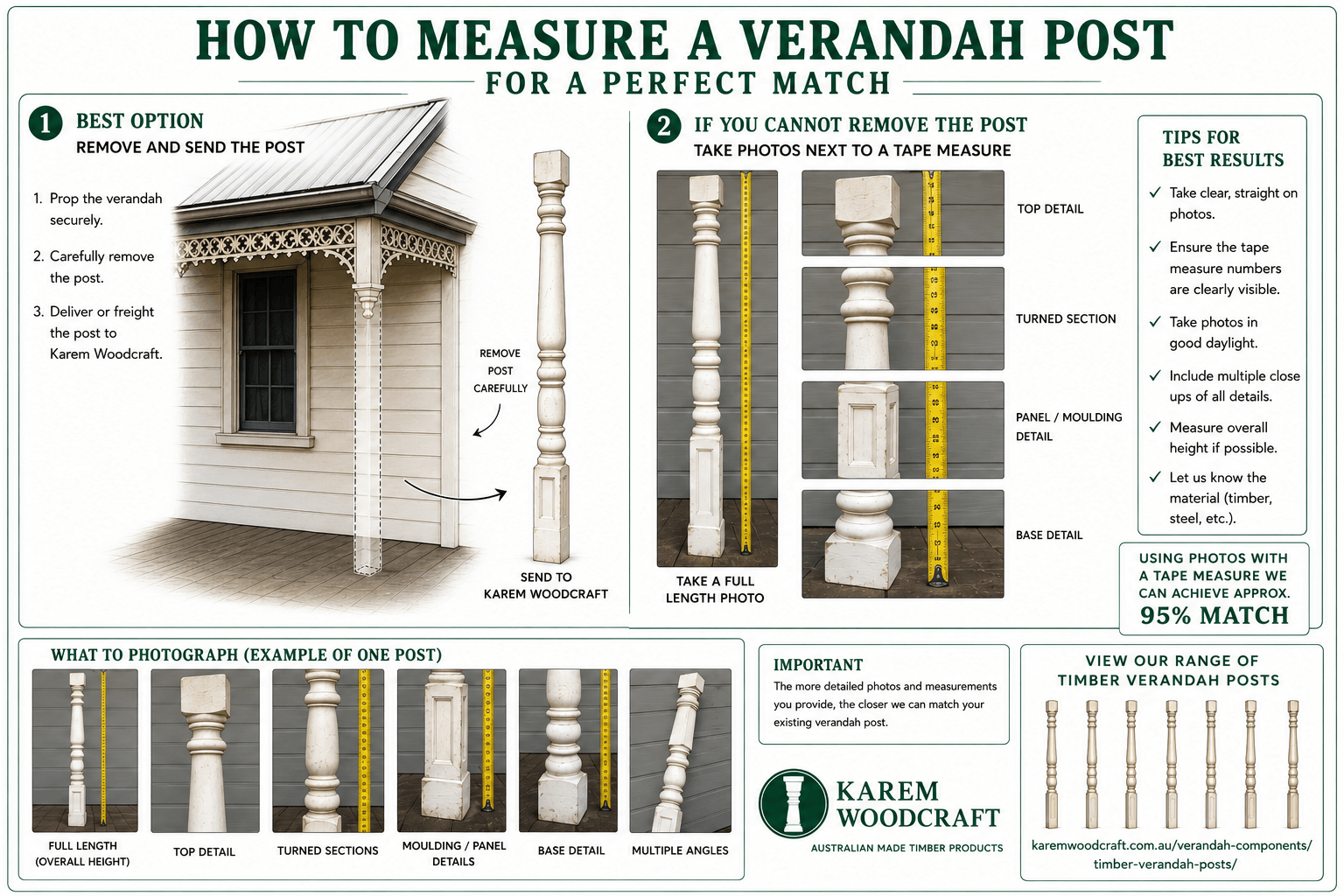
- Prop and support the verandah roof securely before touching the post.
- Ease the original post out carefully so the profile stays intact.
- Drop it in to our Bayswater workshop, or freight it to us for copying.
Never remove a load-bearing post until the verandah is properly supported. If you have any doubt about the structure, engage a qualified builder or carpenter to do this part for you.
Can't Remove the Post? Measure and Photograph It Instead
Plenty of verandah posts are structural and simply cannot be pulled out without a rebuild. When that is the case, a set of well-composed photos taken alongside a tape measure lets our team scale the profile from the images. In most instances this approach still delivers a replacement that matches the original to around 95 per cent.
The key is to lay a tape measure flat against the post and shoot each photo square-on rather than from an angle. Straight, clear images are what allow us to read the true dimensions.
The Photos and Measurements We Need
- One full-length shot of the entire post with the tape measure running beside it.
- Close-ups of the top and capital section.
- Close-ups of every turned or shaped section.
- Close-ups of any panels, chamfers or moulding detail.
- Close-ups of the base or plinth.
- Views from several angles so we can read the profile fully.
- The overall floor-to-beam height of the post if you can measure it.
As a rule, the more detail you give us, the more precisely we can reproduce your replacement.
Tips for the Sharpest Possible Match
- Shoot each photo straight on, keeping the camera level with the detail.
- Make sure the numbers on the tape measure are clearly legible.
- Photograph in natural daylight wherever you can.
- Take extra close-ups of any intricate turned or carved detail.
- Include shots of damaged or worn sections so we can allow for them.
- Tell us the material, whether it is timber, steel or something else.
- Note the overall post height if you know it.
Verandah Post Styles We Regularly Reproduce
Our turners are used to working from originals across the full range of Australian heritage styles, including Victorian, Federation, Colonial and Queenslander posts, as well as decorative, plain turned and entirely bespoke designs. Whether you need a single post replaced or an entire verandah restored, we can match the set. You can browse the full range on our timber verandah posts and heritage products page.
Why an Accurate Match Is Worth the Effort
A mismatched post stands out instantly and can quietly erode the character, and the value, of a heritage home. Restoration clients almost always need replacements that echo the original design closely, preserving the streetscape and the integrity of the property. This matters most for Victorian and Federation restorations, period renovations, and full verandah reconstruction projects where consistency across every post is essential.
What Timber Are Our Verandah Posts Made From?
Our standard verandah posts are turned from LOSP H3 treated pine, engineered for above-ground exterior use. The H3 treatment guards against fungal decay and insect attack, making it a dependable choice for Australian conditions and long-lasting outdoor timber components.
Prefer a Different Timber Species?
Treated pine is our go-to, but we can also produce custom posts in alternative timbers on request. If you are matching an existing post, let us know what species is currently installed and we will advise on the best replacement to suit. Classic Woodturning is part of the Karem Woodcraft family, and the original heritage range from Karem Woodcraft sits behind everything we turn today.
Frequently Asked Questions
How do I work out my verandah post style?
Many period homes carry Victorian, Federation, Colonial or custom turned posts. Send us clear photos and we will help you identify the style.
Can you match an existing verandah post?
Yes. We routinely turn replacement posts by working from original samples, photographs and measurements.
What if my post is damaged or partly rotten?
Even a cracked, split or partially decayed post can usually still serve as a template for a faithful replacement.
Do you deliver across Australia?
Yes. We manufacture in Bayswater, Victoria and deliver replacement verandah posts Australia-wide.
Can you reproduce the decorative detail?
In most cases, yes. Turned sections, mouldings, bases and capitals can generally all be replicated.
Ready to Match Your Verandah Post?
For the tightest match, send us the original post so we can copy it directly. If removing it isn't practical, photograph it square-on with a tape measure alongside and we can usually reach around a 95 per cent match. Call our Bayswater workshop on 03 9720 7266 or drop in to 852 Mountain Highway, Bayswater to get your heritage verandah restoration under way.