Getting a set of outdoor timber stairs right starts long before the first board is cut. A little planning around height, reach and tread count saves money, avoids awkward angles and delivers steps that feel comfortable underfoot. This guide walks you through the essentials of timber stair options so you can measure with confidence and order the right stringer for your deck or verandah.
Understanding Rise and Going in Timber Stairs
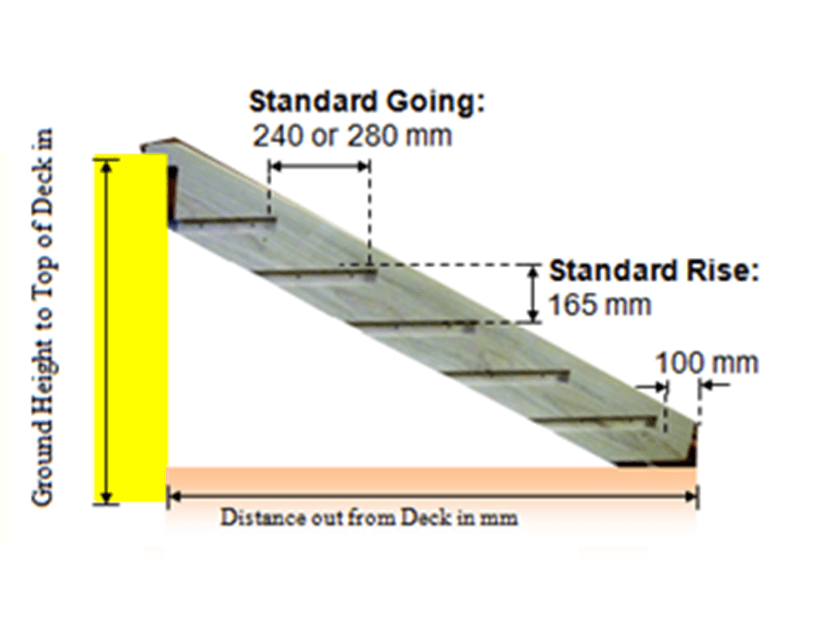
Two measurements shape every staircase. The rise is the vertical distance you need to climb, measured from ground level up to the top of your deck or verandah. The going is how far the stairs travel horizontally, or the distance the flight projects out from the wall or deck edge. Once you know these two figures, everything else, including how many treads you need and how steep the stairs will be, falls into place.
As a working example, a five-step stringer built with a 240 mm going will span roughly 990 mm from the deck down to the ground, and project about 1300 mm out from the wall. Change the rise or the going and the number of steps changes with it, which is exactly why measuring accurately at the start matters so much.
Step Widths: 240 mm and 290 mm Explained
The going of each individual step, often called the tread depth, is where comfort really lives. A narrower 240 mm step suits tighter spaces and steeper climbs, while a more generous 290 mm step gives a shallower, easier gradient that feels relaxed underfoot and is kinder on knees. Neither is better in absolute terms; the right choice depends on how much horizontal room you have and how gentle you want the climb to be. Where space is limited, the 240 mm option lets you gain height in a shorter footprint.
How to Work Out the Number of Treads
Calculating your tread count is a straightforward two-part process:
- Measure your rise. Take the vertical height from finished ground level to the top of the deck. This is the total distance the staircase must climb.
- Measure your going. Note how far out from the deck or wall the stairs can extend without crowding a path, garden bed or boundary.
With those two numbers in hand, you can match them against a standard stair options chart to read off the number of steps required for either a 240 mm or 290 mm going. The taller the rise, the more treads you will need; the more horizontal room you allow, the shallower and more comfortable each step becomes.
Choosing Your Timber
Material choice affects durability, appearance and cost, so it pays to pick with the finished look and location in mind. The three most popular options for outdoor timber stairs are:
- CCA treated pine - a robust, cost-effective structural timber that resists rot and insect attack, ideal for hardworking steps that will be painted or left to weather.
- LOSP treated pine - a cleaner-finishing treated pine that takes paint and stain beautifully, well suited to stairs on show near entries and verandahs.
- Merbau - a rich, dense hardwood prized for its warm colour and natural durability, perfect when you want the timber itself to be the feature.
Custom Timber Stairs Made to Your Measurements
Real decks and verandahs rarely land on a neat round number, and that is fine. Heritage timber stairs can be manufactured to suit your exact ground-to-deck height, so there is no need to force your build to match a fixed template. In practice this means any rise, any timber and any going can be produced to order, giving you steps that fit your home precisely rather than a close-enough compromise.
Matching the stairs to the rest of your outdoor timber, from verandah posts and balustrades through to fretwork and gable detailing, keeps the whole facade looking considered and cohesive. You can browse the full heritage timber range on our timber products page to see how stairs sit alongside the other elements of a classic Australian streetscape.
Bringing It All Together
Comfortable, long-lasting timber stairs come down to three decisions: nailing down your rise and going, selecting a 240 mm or 290 mm step to suit the gradient you want, and choosing a timber that matches the setting. Get those right and you have a flight of stairs that looks the part and lasts for decades.
Any rise, any timber, any going. Made to measure so your stairs fit your home, not the other way around.
This heritage stair range is part of the original timber collection produced by Karem Woodcraft, the Australian-owned family of craftspeople behind decades of made-to-order verandah posts, balustrades, fretwork and timber stairs. If you are unsure which stair option suits your project, a quick chat about your measurements is the easiest way to get it right the first time.