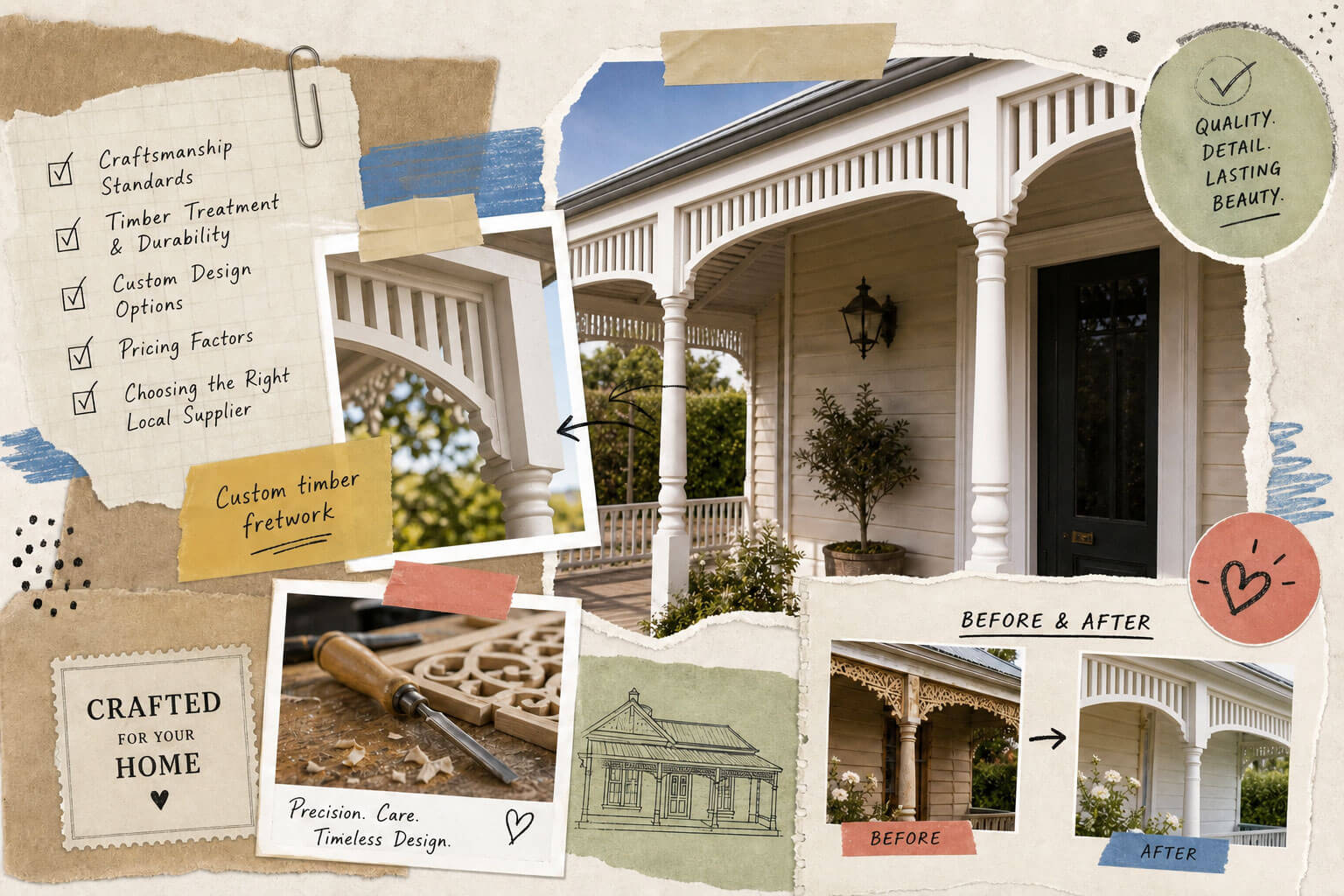
On a heritage or period home, the verandah does most of the talking. It is the feature people register first from the footpath, and getting its timber details right is what separates a faithful restoration from a well-meaning renovation that never quite settles.
Whether you are reviving an original Victorian frontage, updating a Federation cottage or building period character into a newer house, the trick is coherence. Posts, fretwork, brackets, balustrades and the roofline all need to belong to the same architectural era and work as one composition.
Begin With the Verandah Posts
The posts set the mood for everything above and around them. Their profile decides whether a verandah reads as ornate and Victorian or restrained and Edwardian, so they are the sensible place to start any design.
Turned Timber Posts
Turned posts are shaped on a lathe into rounded, decorative profiles and are the signature look of Victorian and early Federation homes. They carry a classic, ornamental feel and pair naturally with lace fretwork, corner brackets and matching turned balusters.
Routed and Square Posts
Squared posts with chamfered edges, rebates or routed detailing suit Edwardian houses, later Federation homes and simpler heritage designs. Adding a capital to the top and a mould to the base lifts a plain post into something considered and period-correct.
Layer in Fretwork, Friezework and Brackets
Timber fretwork is the element most people picture when they think of a traditional Australian verandah. The terms fretwork and friezework are often used interchangeably, though friezework specifically describes the decorative panel running horizontally between the tops of the posts.
The Verandah Frieze
The frieze spans the front of the verandah between posts and creates that unmistakable lacework silhouette against the sky. It is the single detail that most defines the roofline's character.
Decorative Brackets
Brackets are the curved or scrolled pieces fitted where each post meets the beam. Corner brackets soften that junction and add depth. Pattern choice matters here: fine, busy lacework leans Victorian, while cleaner geometric shapes suit Federation and Edwardian homes. Echoing any surviving original pattern is what makes new work look like it always belonged.
Choose a Balustrade That Suits the Era
A verandah balustrade is both a safety element and a design opportunity. If your verandah carries a railing, treat it as another chance to reinforce period character.
- Turned balustrades deliver a rich, traditional look ideal for Victorian and Federation homes.
- Fretwork infill panels offer a lighter, more decorative feel while keeping the heritage flavour.
- Square balustrades suit Edwardian and more transitional, restrained designs.
Fretwork and balustrades are typically priced per lineal metre, so plan the height and baluster spacing to meet the relevant requirements from the outset rather than reworking it later.
Do Not Forget the Roofline
The roof shapes the whole profile of the home. A well-detailed roofline makes a verandah feel finished, while a neglected one leaves it looking half-built.
Bullnose, Gabled and Skillion Forms
The rolled bullnose roof is a classic Victorian and Federation feature. Gabled verandahs open the door to finials, decorative gable infill and barge boards. Even a plain skillion verandah gains presence with the right brackets and fretwork underneath.
A Quick Guide by Architectural Era
Victorian verandahs favour ornate turned posts, fine lace fretwork, corner brackets, turned balustrades and bold colour contrast. Federation verandahs suit turned posts with capitals, geometric fretwork, gable finials and warmer, softer tones. Edwardian and later homes call for routed or square posts, simpler fretwork, cleaner lines and subtle colour schemes.
Matching Old Details to New
Many owners worry about blending replacement components with surviving originals. As the original heritage range behind the family, Karem Woodcraft can often reproduce posts, fretwork, friezework, brackets, finials, balustrades, handrails and mouldings from photographs, measurements and existing samples. The goal is straightforward: same profile, same proportions, same style, so old and new sit together seamlessly. You can explore the full range of heritage timber products to see what can be matched.
Matching every element to one era is what makes a verandah feel coherent rather than collected.
A Practical Place to Start
- Photograph your existing verandah, and neighbouring homes of the same era for reference.
- Identify the current post style and note any surviving fretwork, friezework or brackets.
- Measure post heights, post spacing, fretwork spans and balustrade heights.
These few notes give you a solid brief for a verandah that looks as though it has always been part of the home, crafted in Australia and delivered Australia-wide.