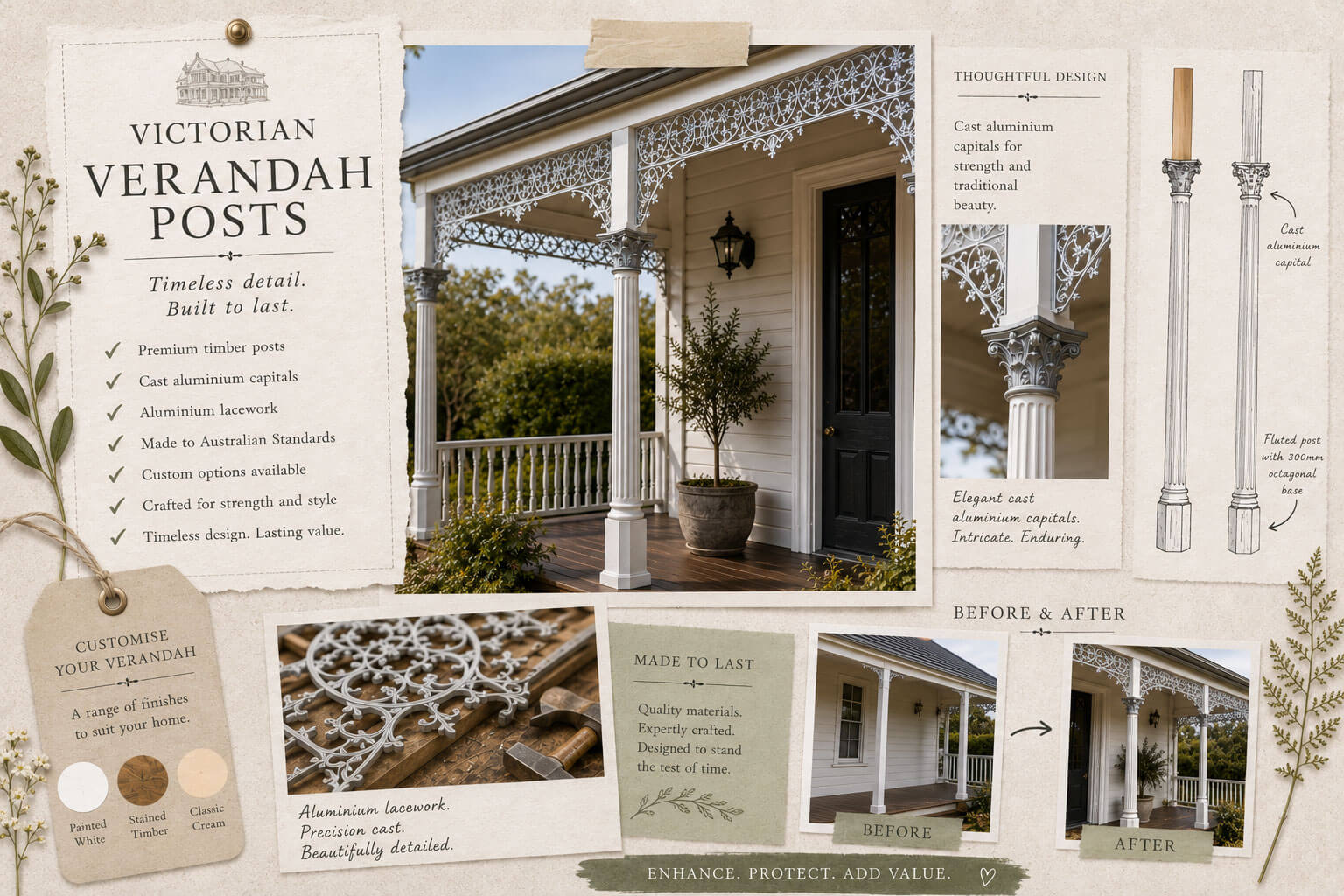
When a single verandah post fails at the base, the real headache is rarely the timber itself. It is matching that one lost post to the survivors already standing on your heritage home. This guide walks you through identifying the style, choosing the right timber, measuring for a faithful replacement, keeping rot at bay, and deciding between stock and custom.
What Sets a Victorian Verandah Post Apart
The signature of a Victorian verandah post is its turned mid-shaft. Instead of a plain straight column, the timber carries decorative rings, coves and beads shaped on a lathe, giving the post a sculptural presence that square or flat posts never achieve. That ornament was deliberate. Homes built roughly between the 1850s and 1900s treated verandah detailing as a marker of status, and the posts were central to the display.
This is also how you tell Victorian work apart from Edwardian or Federation posts, which lean toward slimmer, more restrained shapes. Bold, layered turning with pronounced rings and a decorated capital points firmly to Victorian-era craftsmanship. A minimal profile with a near-plain shaft usually signals a later period.
The Three Zones of a Turned Profile
Every Victorian post breaks down into three parts: the capital at the top, the turned shaft in the middle, and the base at the foot. The capital carries a projecting moulded head that meets the verandah beam, while the base sits on a plinth block or mounts to a base plate at floor level. The shaft draws on classical moulding vocabulary such as ogee curves, scotias, beads and torus rings, all following a proportional rhythm. Get those proportions wrong on a reproduction and it reads as off next to an original, even to an untrained eye.
Diagnostic Details to Look For
Two features are especially telling. The first is an octagonal or stop-chamfered base, where square timber steps to eight faces before the base plate. The second is a projecting block or moulded capital up top, ranging from a simple chamfered head to an elaborate acanthus-style crown. The shaft turning is the hardest element to replicate off the shelf, which is exactly why specialist profile matching matters.
The Timbers Behind Victorian Verandahs
Original builders used whatever species were available and affordable locally, so a Melbourne terrace post and a Queensland homestead post might share a profile but come from entirely different timbers.
Hardwoods, Cedar and Softwoods
Durable Australian hardwoods such as ironbark, spotted gum and tallowwood suit structural work thanks to their density and natural resistance to decay. Australian red cedar was the prize timber for fine turned joinery through the early to mid-Victorian years, valued for its workability and straight grain. As cedar tightened late in the century, Queensland kauri, hoop pine and Baltic pine filled the gap in better painted joinery, while white pine and Baltic pine served economy builds. Softwoods paint well but are far more prone to rot at the base without regular maintenance.
Treated Pine for Modern Reproductions
For new reproduction posts, LOSP H3 treated radiata pine is a practical choice for painted exterior use. It turns cleanly on the lathe, holds paint reliably, and resists the termite and fungal decay that ended so many original posts. Confirm current treatment specifications with your supplier when ordering.
Measuring for a Period-Accurate Replacement
Victorian posts followed no national standard, so originals may not match any stock size. In supplier catalogues, square sections generally run from 88x88 mm up to 140x140 mm, round turned profiles span 100 mm to 150 mm diameter, and stock lengths sit between 2.4 m and 4.5 m. Single-storey verandahs usually call for 2.4 m to 3.0 m posts, while two-storey verandahs push toward 3.6 m to 4.5 m.
How to Record an Existing Post
- Ground to top of capital - the installed height from floor to the very top of the capital.
- Overall height - the full length of the post.
- Thickness of the square - the dimension across a flat face before turning, such as 90 mm, 100 mm or 140 mm.
Then photograph the post head-on and from each side, with close-ups of the moulding to capture the depth and spacing of every bead and cove. A profile match is only ever as good as the information you supply.
Installing Posts and Stopping Rot at the Source
A well-made post lasts generations, but failure almost always starts with moisture at the base. Surface-mount base plates suit new construction where water can drain freely. Fascia-mount systems are best over waterproofed membranes, since they avoid puncturing the layer. Traditional plinth blocks are the most period-authentic option where the structure below is sound and dry.
Keep the post base slightly proud of the floor so water cannot pool against the end grain, and use composite shims rather than timber, which rots and compresses over time.
Use corrosion-resistant fasteners, with stainless steel screws as the standard and galvanised hardware only where ratings suit the environment. Repainting the base section every three to five years remains one of the most effective long-term protections.
Sourcing: Stock Versus Custom
Stock Victorian-style posts work well when you are fitting a complete new set with nothing to match, offering the era's character with shorter lead times. When you need to replicate surviving originals, matching the same beads, capital projection and shaft proportions, custom turning is the only genuine answer. As a guide, turned timber posts range from around $406 to $797 each depending on profile, size and species, with custom work quoted individually.
For heritage restorations, the heritage range from Karem Woodcraft is built around exactly this kind of faithful profile replication. Browse the full timber verandah posts range to compare profiles for your project, and order early so lead times never stall your build. A mismatched post draws the eye; a well-matched one disappears, which is precisely what a successful restoration should look like.