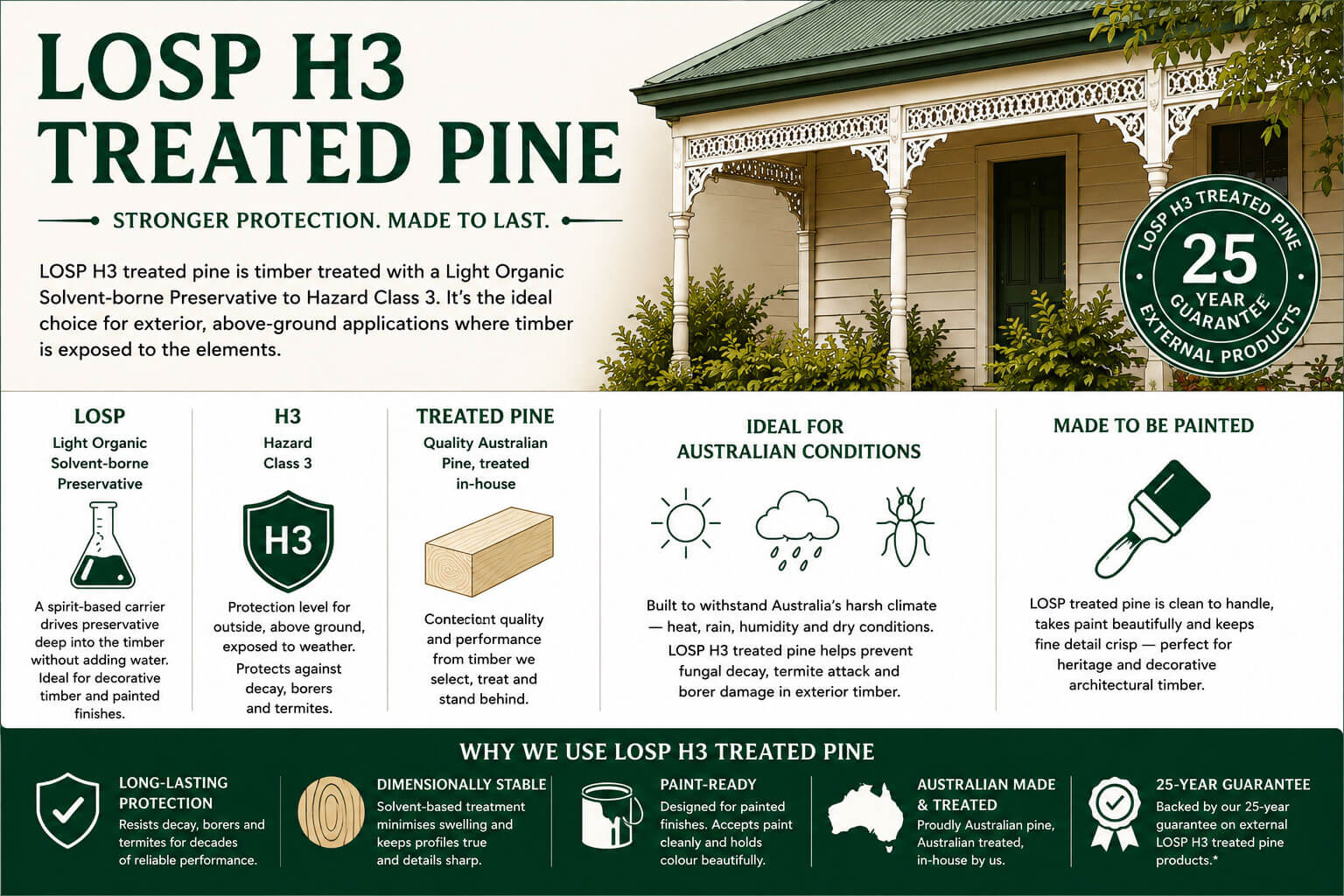
If you have priced verandah posts, fretwork or balustrades lately, you have almost certainly come across the term "LOSP H3 treated pine". It sounds technical, but the idea behind it is simple: it is pine that has been treated so it can cope with life outdoors, above the ground, in a harsh Australian climate. Here is what that actually means for your heritage timber project.
What Does LOSP H3 Treated Pine Actually Mean?
The name is really two ideas bolted together. LOSP describes how the timber is treated, and H3 describes what it is protected against. Understanding both halves makes it much easier to choose the right timber for exterior architectural work.
LOSP: Light Organic Solvent-borne Preservative
LOSP stands for Light Organic Solvent-borne Preservative. Rather than carrying the protective chemicals into the timber with water, the treatment uses a light organic solvent. That distinction matters for decorative work. Because water is not driving the preservative into the grain, the timber holds its shape and keeps its crisp machined detail. It also takes paint beautifully, which is exactly what you want for fine profiles and heritage joinery.
H3: The Above-Ground Weather Class
H3 is one of Australia's timber hazard classes. It is the rating for timber used outside and above the ground, where it is exposed to the weather but is not sitting in soil. The hazard classes run in a sequence, each one built for a tougher environment:
- H1 and H2 - interior timber, such as joinery and wall framing.
- H3 - outdoor, above-ground, weather-exposed timber: verandah posts, fretwork, brackets and balustrades.
- H4 - outdoor timber in direct ground contact, like fence posts.
- H5 and H6 - severe in-ground wetting and marine conditions.
The key takeaway is that H3 is an above-ground rating. It is perfect for a verandah post standing on a stump or bearer, but it is not designed to be buried in the earth.
Why Choose LOSP H3 for Heritage Timber?
Left untreated, pine exposed to the elements is an easy target. Australian weather and pests can bring on fungal decay, termite and borer attack, moisture damage and premature rot. LOSP H3 treatment lifts the timber's durability for exterior above-ground use while preserving the fine detail that heritage work depends on.
That combination is why it suits our climate so well. Exterior timber here has to shrug off blazing sun, heavy rain, humidity, long dry spells and constant temperature swings. H3 treated pine is engineered for exactly that above-ground exposure, which makes it a natural fit for Victorian and Federation verandahs and decorative external products. You can see the range of posts, fretwork and balustrades it is used for on our timber products range.
How It Compares to CCA and ACQ
You may also have heard of CCA and ACQ. These are water-based treatments generally chosen for structural, landscaping and in-ground jobs. For painted heritage timber, though, LOSP H3 is usually the better pick. It is cleaner to work with, more dimensionally stable, and far better suited to finely machined profiles and delicate decorative detailing.
Painting and Maintaining LOSP H3 Pine
Here is the part that gets overlooked most often: treatment alone is not enough. LOSP H3 pine still needs to be correctly primed, painted and maintained. Think of it as two layers of defence working together. The treatment guards the timber itself, while the paint system shields the surface from the weather.
Once your posts or fretwork are installed and painted, give them a regular look-over. Any paint that is cracked, peeling, chipped or worn should be touched up promptly so the timber stays sealed. Pay particular attention to the spots that cop the most punishment:
- Cut ends and freshly trimmed edges
- Joins and natural checks in the grain
- Screw holes and fixing points
- Impact marks and knocks
- Exposed edges and high-weather areas
The treatment protects the timber, but the paint system protects the surface. Keep the paint sound and your timber will reward you for decades.
When Hardwood Might Suit Better
Treated pine is not the answer for every job. For elements that take heavy wear or need extra strength, such as stair treads and stringers, a durable hardwood like Merbau can be the smarter choice. It is always worth matching the timber to the specific demand of the application.
The Bottom Line
LOSP H3 treated pine is purpose-built for exterior, above-ground heritage timber in Australian conditions. It keeps fine detail sharp, resists rot and pests, and takes paint superbly, which is why it is our go-to for verandah posts, fretwork, brackets and balustrades. Look after the paintwork with regular inspections and prompt touch-ups, and it will serve your home for generations. Classic Woodturning is proud to carry forward the original heritage range pioneered by our parent company, Karem Woodcraft, with the same in-house treatment and craftsmanship.