Internal fretwork is one of those finishing touches that quietly transforms a room, framing doorways, archways and hallways with the kind of crafted timber detail that mass-produced trim simply cannot match. If you are weighing up a design for your own place, the challenge is rarely a lack of options; it is knowing which style genuinely suits your home. This guide walks you through the decisions that matter.
Start With Your Home's Era and Character
The single most reliable guide to internal fretwork is the age and style of your house. Decorative timber fretwork, also known as friezework, timber frieze or heritage lacework, evolved alongside particular architectural periods, so matching the pattern to the era keeps the result looking intentional rather than bolted on.
Victorian and Colonial Homes
Victorian and Colonial interiors carry ornate, flowing detail. Intricate scrollwork, curved arches and fine pierced patterns, often described as Victorian lacework, feel right at home above a wide hallway or between formal rooms. The more elaborate the existing cornices and skirtings, the busier your fretwork can be without looking out of place.
Federation and Edwardian Homes
Federation interiors tend to be a little more restrained. Look for balanced, geometric friezework with softer curves. These patterns bridge the gap between high-Victorian ornamentation and cleaner twentieth-century lines, making them a versatile choice for renovated period homes.
Queenslanders and Contemporary Homes
Queenslanders welcome open, airy fretwork that emphasises ventilation and light. In modern and coastal builds, a simpler repeating motif or a straight decorative panel adds warmth and interest without competing with a minimalist scheme.
Arched or Straight Fretwork?
Once you have a style in mind, the next decision is the profile. Arched fretwork drops down beside each side of an opening and dips in the centre, creating a graceful, framed effect that suits wide archways and doorways. Straight fretwork runs level across the top of an opening and works beautifully in narrower spaces or where you want a cleaner, more understated line. Both can be tailored to the exact width of your opening, so the choice is largely aesthetic.
Matching Timber, Finish and Room
Internal fretwork is typically supplied ready for painting, which gives you enormous freedom. A crisp white finish keeps heritage detail light and lets the pattern read clearly, while a stained or timber-toned finish leans into a warmer, more traditional feel. Consider the room, too: fretwork above a hallway arch sets a welcoming tone the moment you walk in, whereas fretwork framing a lounge or dining opening defines the space without closing it off.
Standard Designs Versus a Custom Match
You do not always need a bespoke pattern. There is a broad range of standard timber fretwork and friezework designs suited to new interiors, heritage-style renovations and period restorations, and choosing from an existing range is usually the fastest and most cost-effective path.
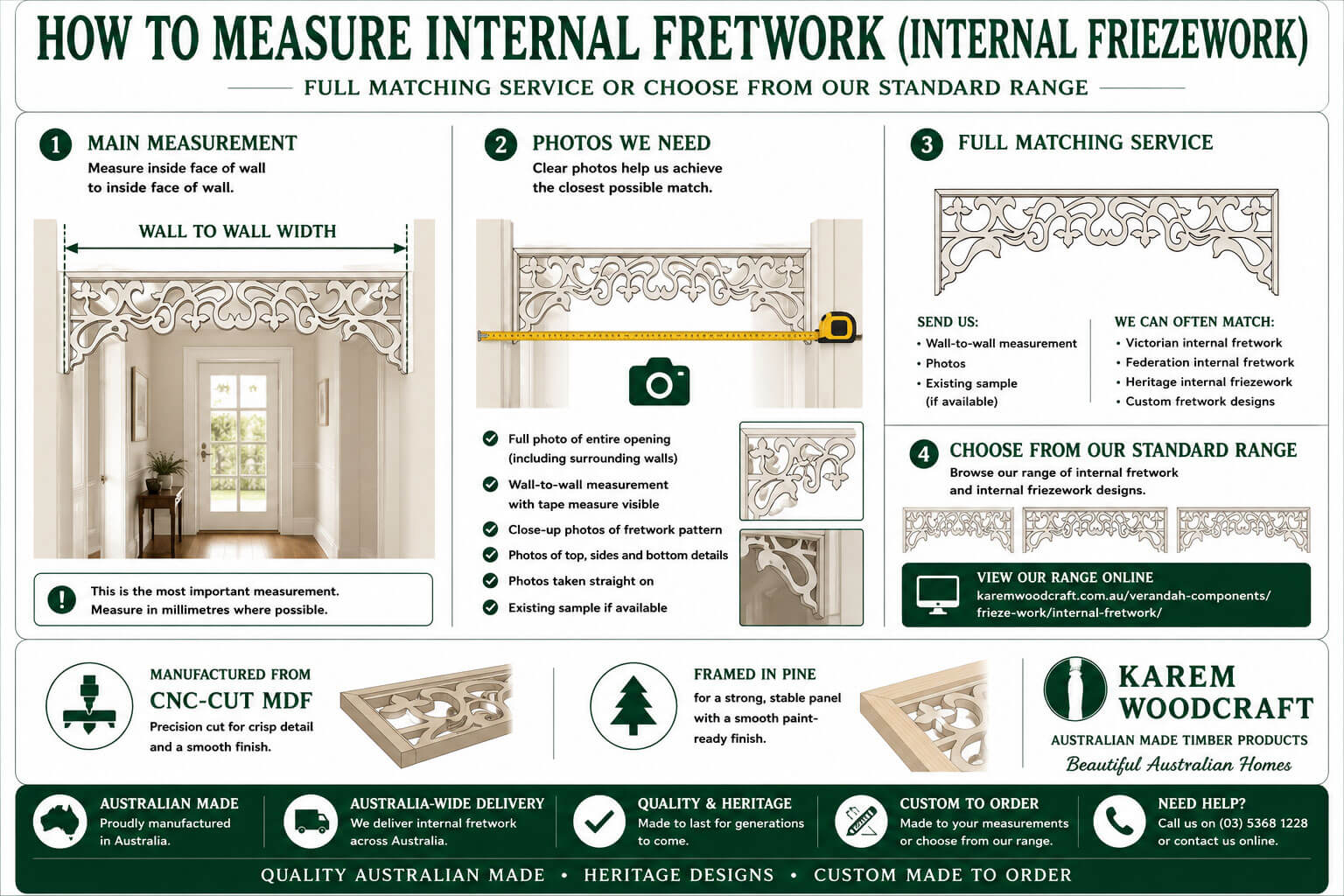
If you are restoring a home and want to echo original detailing elsewhere in the house, a custom match is worth considering. Providing clear, straight-on photographs alongside the opening measurements allows a heritage timber manufacturer to reproduce scroll patterns, curves and proportions faithfully. You can browse a full selection of styles and finishes on our timber fretwork range to narrow down what appeals before you commit.
Understanding How Fretwork Is Priced
Fretwork and friezework are generally priced per lineal metre, which makes budgeting straightforward: once you know the width of the openings you want to dress, you can estimate the cost quickly. More intricate patterns and wider arched panels naturally sit at the higher end, while simpler straight profiles keep costs down. Measuring your openings accurately before you enquire helps you compare designs on a like-for-like basis.
Getting the Measurements Right
Whatever style you choose, a few key measurements make ordering painless. For a straight panel, you need the opening width and the height of the fretwork. For an arched panel, add the side drop beside each edge and the centre drop in the middle of the opening. These figures let the workshop produce a panel that fits your space precisely the first time.
The best-looking fretwork is the piece that suits the bones of your home, so let the era, the proportions of the opening and your finish do the choosing for you.
Where the Heritage Range Comes From
Classic Woodturning's internal fretwork draws on the original heritage catalogue of its parent company, Karem Woodcraft, an Australian-owned manufacturer of verandah components, friezework, balustrades and decorative timber products. That shared range means you can specify a genuine period pattern, have it made in Australia and delivered nationwide, and finish it to suit your own interior.
Ready to Choose?
Settle on your home's era first, decide between arched and straight, then match the finish to the room. With those three decisions made, selecting the right internal fretwork becomes far simpler, and the result will look as though it was always part of the house.